
1947 : The Baksi Aftermath
Hope Turns to Disappointment, Relief and Rumours
It was Bruce’s first home defeat. Hundreds of people had lined Mona Road outside Bruce’s parents’ home until late in the night after the fight had been broadcast and long concluded. But the house remained silent and dark. A few friends tapped on the door but there was no response. There was no sign of Bruce’s mother, who had said earlier in the day that she intended listening to the contest on the radio alone, her husband Sam being part of the ring-side team as always. Gradually the well-wishers dispersed. At 12 Malton Road, Nora, also alone, had listened to the fight. She didn’t usually do so. Afterwards, she wished she hadn’t and said the only part she like was when the radio commentator announced the fight had been stopped and she was overcome with relief that Bruce might get home in one piece.
Such was the shock of the defeat, unfounded rumours circulated in the press that Bruce was actually dead, after he had relapsed into a stupor from the punishing effects of the fight.
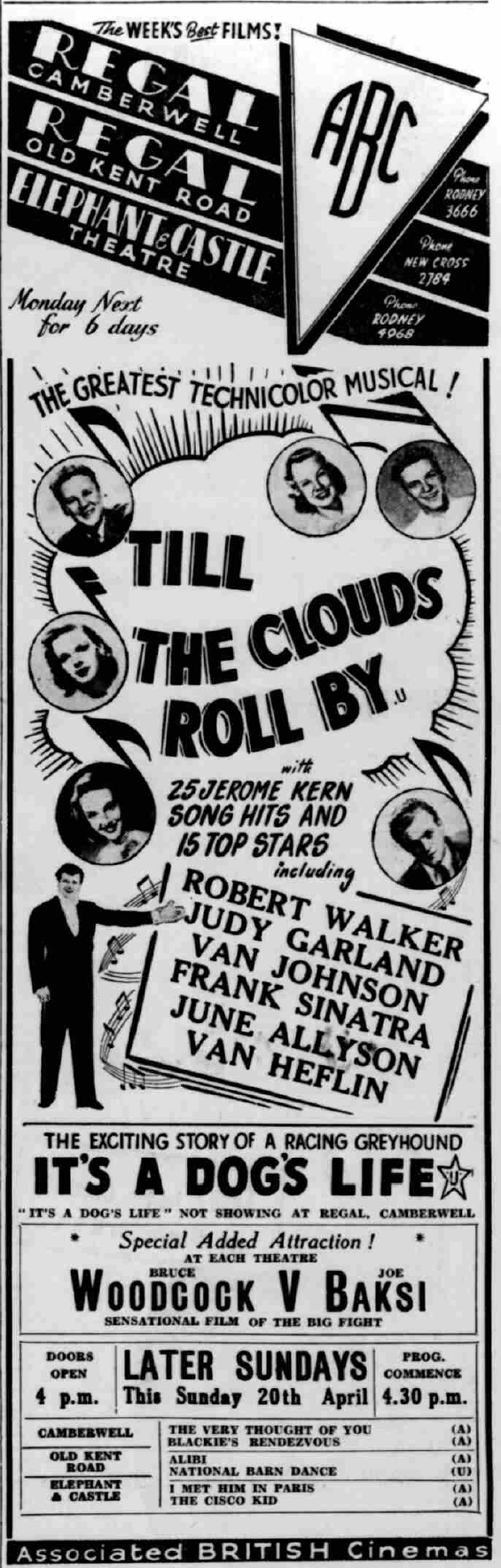
At the same time national cinemas were billing a “Special Added Attraction: Bruce Woodcock v Joe Baksi - Sensational Film of the Big Fight”.
The Truth About the Damage
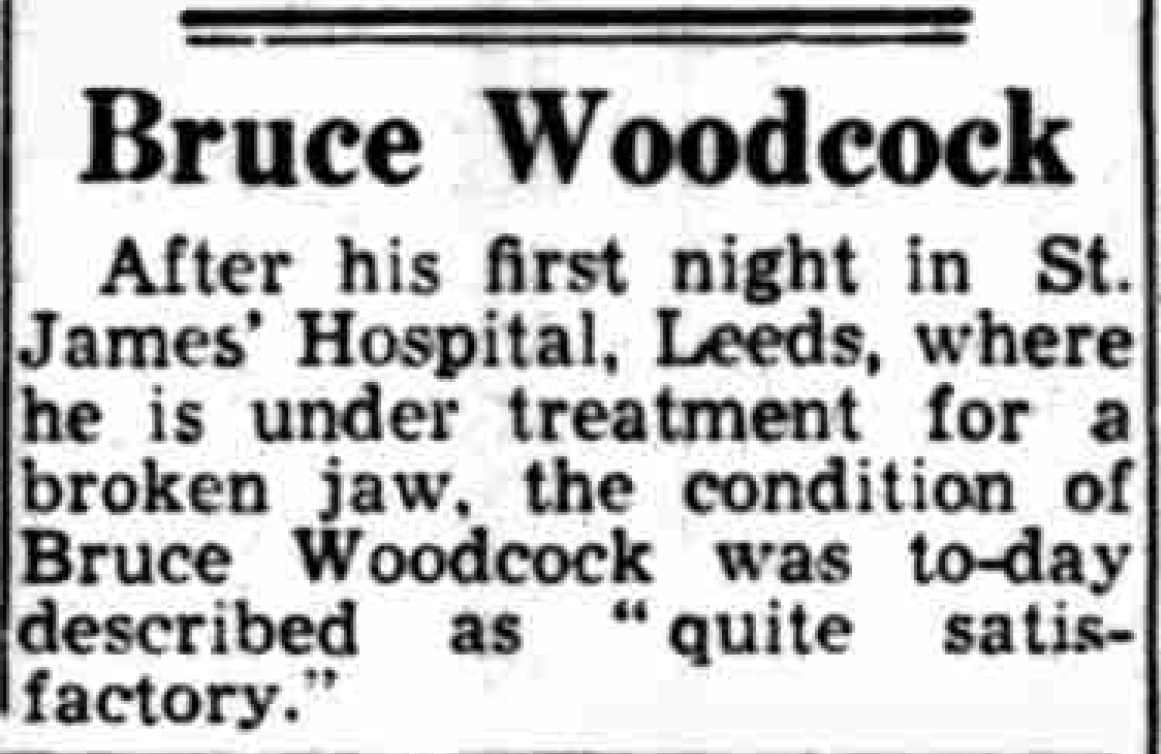
It wasn’t until four days later that the press released the truth about the fight: after his own doctor examined him the next day he declared Bruce ’s temporal bone, the one above the jaw, had been smashed in the first round.
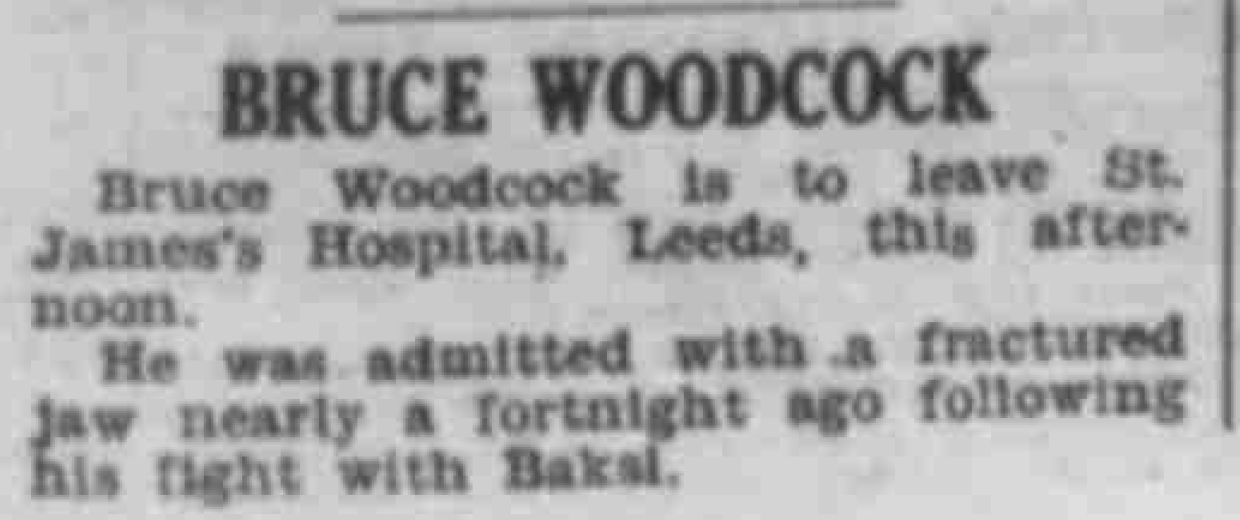
Bruce had been taken to Leeds Royal Hospital to treat a shattered jaw. His his face was shored up with steel splints. According to the ghost-written autobiography
Two Fists and a Fortune, the doctor who examined the X-ray told Tom Hurst “I’ve only seen two other men in my life with temporal bones dented like this chap’s. One tried to slip past a man wielding a sledge-hammer and was struck by the back-swing. The other was a fellow who was struck by the tail-end of a backing truck.” [p. 141].
This account also records that Bruce’s family doctor had tried to console Bruce by saying “The fellow who did that has broken his hand for sure. No knuckle-bone ever made is tougher than that one”, pointing to my temple.” But Baksi suffered no damage to his hand. All of which led the ghosted autobiography to speculate as to “How had Baksi been able to inflict such damage with so ordinary a punch?”, one which ‘Bruce’, as narrator in the book, dismisses scathingly as “a sucker punch”.
The book goes on to describe how Tom Hurst conducted a more thorough than usual ‘inquest’ into this fight, sending for reports and advice to America and getting detailed medical evidence from the doctors. Enigmatically, the book says “I can tell you now that from Tom’s inquest we have since discovered how Baksi managed to get such sledge-hammer force into that almost-casual ‘sucker’ punch. It was Joe’s secret that night. We share it now. . .” But the book doesn’t share “it” with the reader. Instead we get “It’s over and done with, and on the principle that it’s useless to cry over spilt milk I’m saying no more about our ‘inquest’ findings, except that we had our lesson - and learned it.”
Speculation
Brian Hughes in
Battling Bruce takes this material and expands it (the sentence structure here is as in the original):
“After much reasoning and watching a film of the fight several times, akin to the 2009 Antonio Margarito v. Sugar Shane Mosely bandage scandal where Margarito was found to have used a hardening substance on his hand bandages, some 62 years after Bruce had arrived at a conclusion as to why Baksi’s punching damaged him so badly, although he never revealed publicly that he believed something was done to the bandages on Baksi’s hands and he wasn’t on his own with his theory as Freddie Mills and many other people around the boxing establishment at that time had also arrived at the same conclusion.” [131]
Unless he had first-hand knowledge, Hughes is obviously reading Bruce’s “conclusions” into the account of the fight given in the ghosted autobiography. But it’s notable that the autobiography does make a point of raising this whole issue, even if it is presented evasively. This no doubt would not have occurred without the real Bruce Woodcock’s agreement.
Afterwards
After the fight, Baksi was magnanimous in his praise for Bruce’s courage, pluck and determination, and sent Bruce a personal message of concern to the hospital. He also issued a public statement of his “profound regret” for Bruce’s broken jaw. Baksi’s trainer Ray Marcell said: “Woodcock has my sympathy. We won’t want to inflict that kind of damage to any man in a fight whatever is at stake. Bruce is such a game boy that it was a pity he sustained those nasty cuts, but a broken jaw - I am dreadfully sorry to hear about it.”
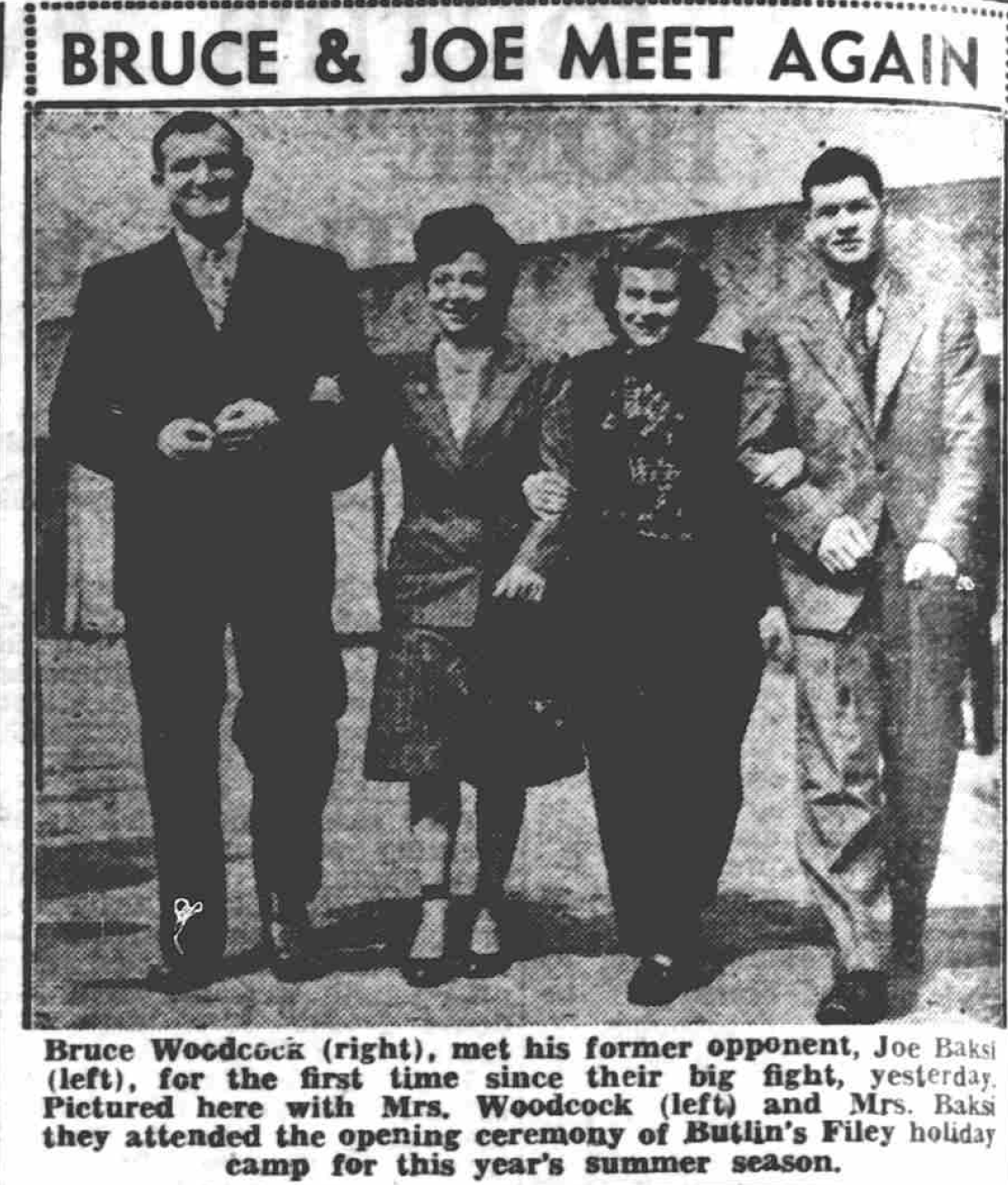
When he was discharged from hospital, Bruce and Nora went on a holiday to Butlins Holiday Cap in Filey, where Joe Baksi came to pay his respects. Baksi was touring some northern coalfields, and at Hickleton Main Colliery, he was confronted by an angry eleven year old Brian Blessed, who was distraught that the American boxer had defeated his hero. Blessed might have had some consolation from the fact that in his next fight just two months later, Baksi was beaten on points over ten rounds by the Swedish heavyweight champion, Olle Tandberg. Despite signed contracts, neither man went on to fight Joe Louis. The elusive world champion had sidestepped them all.
A Tragic Accident
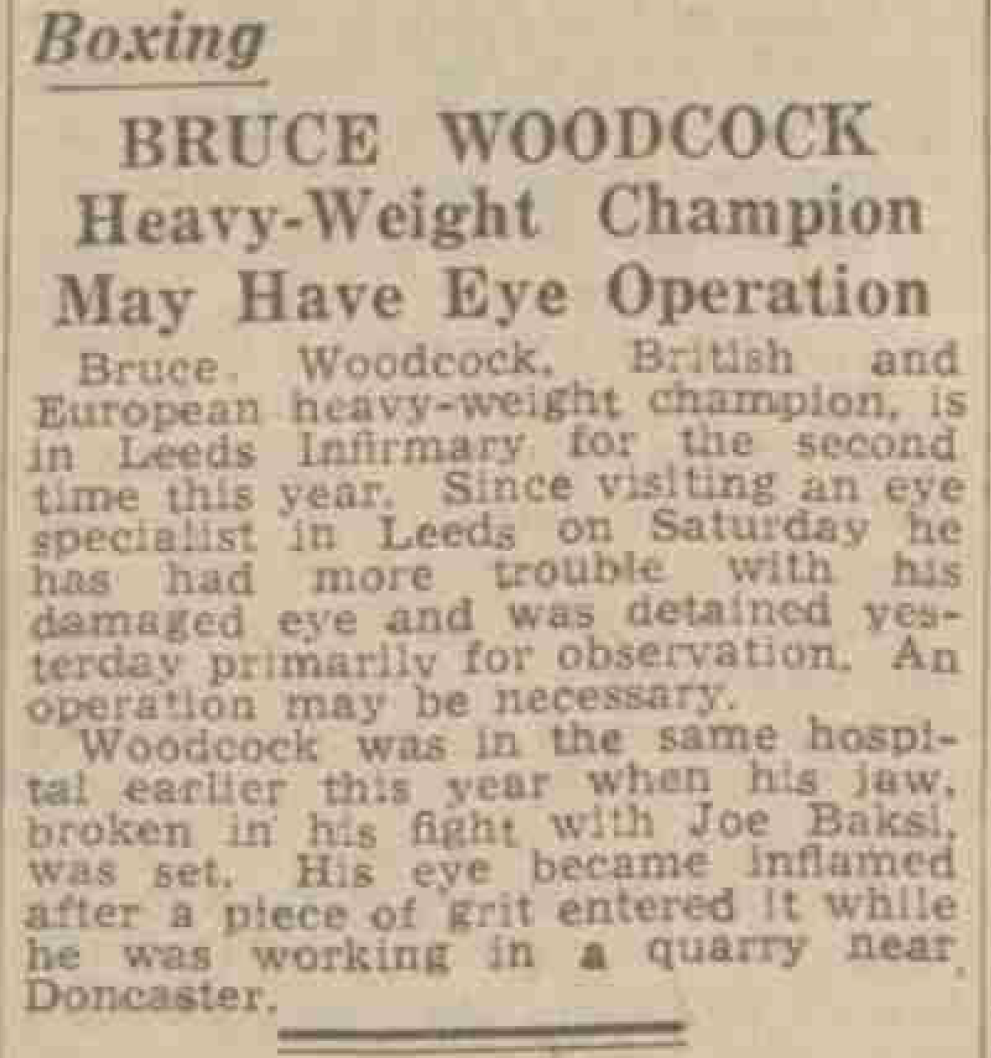
Bruce had recovered from the shattered jaw, but he now faced an equally devastating injury, compounded by the damage inflicted by the Baksi fight. He began light training, and in October Bruce decided some pick and shovel work in a local quarry would help rebuild his arms and shoulders. Unfortunately, a small piece of grit was sent flying and went into his right eye. After attempts to remove it by everyone concerned, Bruce went to Leeds Infirmary where doctors examined him for the grit but found in addition that there were small fragments of the bone from the shattered upper jaw floating loose and endangering the left eye. Any slight jolt might shift them and irreparably damage that eye.
The immediate operation meant that afterwards, Bruce had to remain absolutely still in a darkened room with his eyes bandaged for a whole month. The mental, emotional and physical agony can only be guessed at. To give him some comfort and distraction he took up sucking on an old pipe of Sam’s, never having smoked previously.
The Backlash Begins
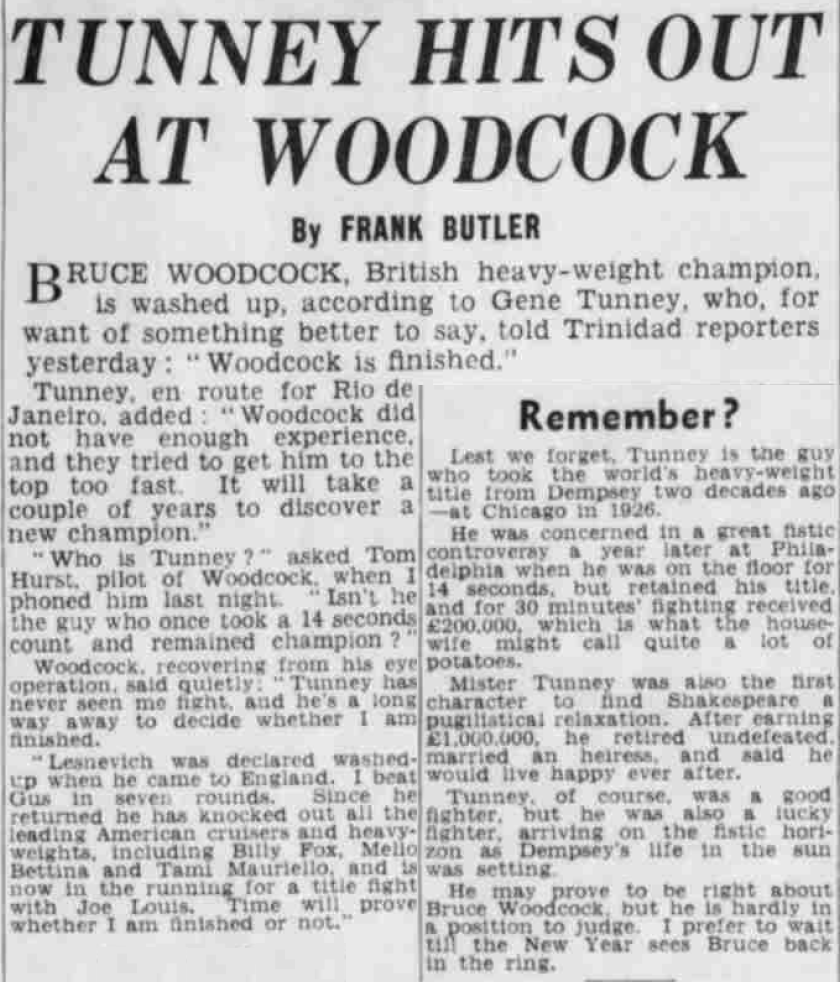
Meanwhile, the beginnings of what, at different times over the next few years, was to become an increasing wave of criticism were beginning to emerge via some parts of the press, as in this example from the Daily Express for Tuesday 11 November:
BRUCE WOODCOCK, British heavy-weight champion, is washed up, according to Gene Tunney, who, for want of something better to say, told Trinidad reporters yesterday: “Woodcock is finished.”
Tunney, en route for Rio de Janeiro, added: “Woodcock did not have enough experience, and they tried to get him to the top too fast. It will take a couple of years to discover a new champion.”
“Who is Tunney ?” asked Tom Hurst, pilot of Woodcock, when I phoned him last night. “Isn’t he the guy who once took a 14 seconds count and remained champion ?”
Woodcock, recovering from his eye operation, said quietly: “Tunney has never seen me fight, and he’s a long way away to decide whether I am finished.
“Lesnevich was declared washed up when he came to England. I beat Gus in seven rounds. Since he returned he has knocked out all the leading American cruisers and heavyweights including Billy Fox, Melio Bettina and Tami Mauriello, and is now in the running for a title fight with Joe Louis. Time will prove whether I am finished or not.”
The Future
After a month, the bandages were removed and the operation declared a total success, though it took weeks to safely start moving again.
It wasn’t until early February 1948 that newspapers started reporting his anticipated release from hospital to return home, after an official statement on 6th February 1948.
After a brief respite, disaster struck again when during a recuperative drive out to the moors with Nora, Bruce had to stop the car because the vision in his right eye was affected. The subsequent visit back to Leeds Infirmary diagnosed a detached retina. The whole agonising process had to be repeated once again with no guarantee of a successful outcome. The uncertainty led Bruce’s youngest brother Bill, his closest sibling, to offer one of his eyes in a retina transplant if needed. Thankfully, when the bandages came off the second time, the doctors again pronounced the surgery successful, and Bruce could again gradually start moving and recuperating.
The pressure on him, on his young wife Nora and on the family is unimaginable. Nora most certainly would have wanted Bruce to retire at that point, and though she kept her thoughts to herself as she always had done, glimpses of how she felt began to emerge later. But Bruce himself gradually decided he would take one last shot at his dream - to become heavyweight champion of the world. And almost unbelievably, in the following year, he made a come-back that once again put him in contention for that title.
In this clip, Colonel Eddie Eagan, New York’s Athletic commission chief, gives his opinion of Bruce after the Woodcock-Baksi match [46 seconds in]:
