
1948: Lee Oma - The Backlash
Norman Hurst Lays in
After the fight, there were some commentators who felt Oma’s performance had brought the sport into disrepute.
Norman Hurst, writing in the Aberdeen Press and Journal was particularly scathing. He was clear about where the blame lay: he headlined the bout “One of Biggest Flops Ever Seen” and went on to say ...
“... it is the first time in many years of watching hundreds of fights that I have seen a boxer twist over on the floor and squirm as did Oma from a punch to the jaw.
This could be accepted from one to the body, but it is a novelty to see the same effect from a punch to the jaw.
In short, the fight which was to herald the British and British Empire champion’s return to the ring after eighteen months’ absence was turned into a travesty that held boxing up to ridicule - and yet it was not Woodcock's fault.
He started off cautiously, but not nervously. Oma had discarded his clowning shown in the gym, and looked to be serious, but after an opening round in which he gave every appearance of being able to serve up some sort of opposition he adopted the role of pacifist.
He took punches which one would have expected an ordinary performer to block. All that we had heard about him was gone by the boards. He had nothing to offer and nothing to show that he was worthy of being in there with Woodcock.”
With an eye to the future, Hurst concluded:
“Britain’s champion cannot be blamed for the pitiful showing of the American. I am only stating a plain fact say that no other American has put up such an inept exhibition ....
.... All we have learned from this contest, if it can be termed as such, is that Woodcock is fitter than was expected, is using his left hand well, and has plenty of dynamite in his right, but the opposition did not enable us to even guess what Bruce’s powers of resistance would be against strong-punching opponent.”
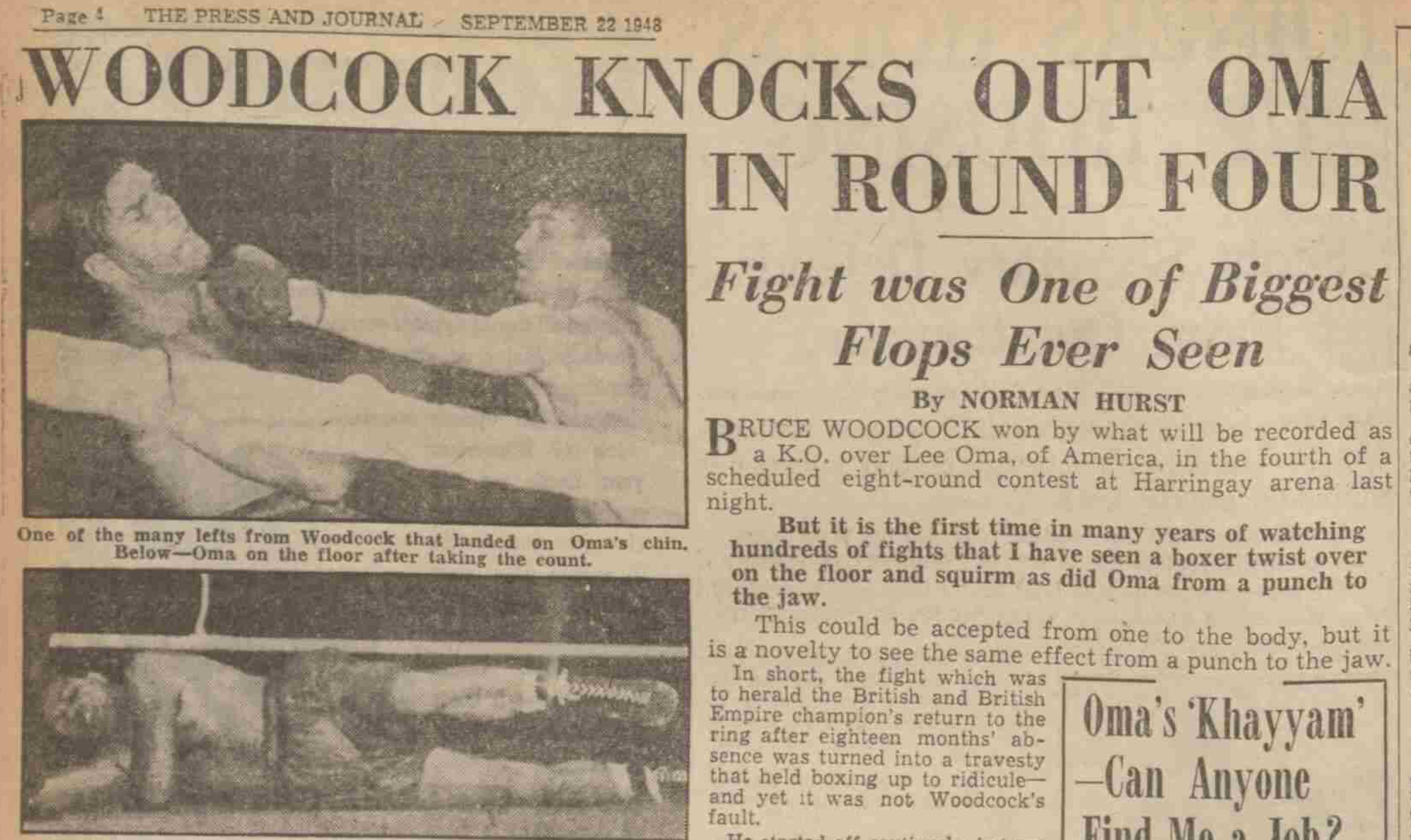
It was generally agreed that Bruce would have benefitted from a more testing contest but at least it meant he had faced the demons of his defeat by Baksi in the same ring the previous year and proved to himself as well as the public that he could still do the job. As usual, immediately after the fight Bruce was on the midnight train home to Nora and their baby son, this time in a fit and undamaged shape.
Oma’s Writhing
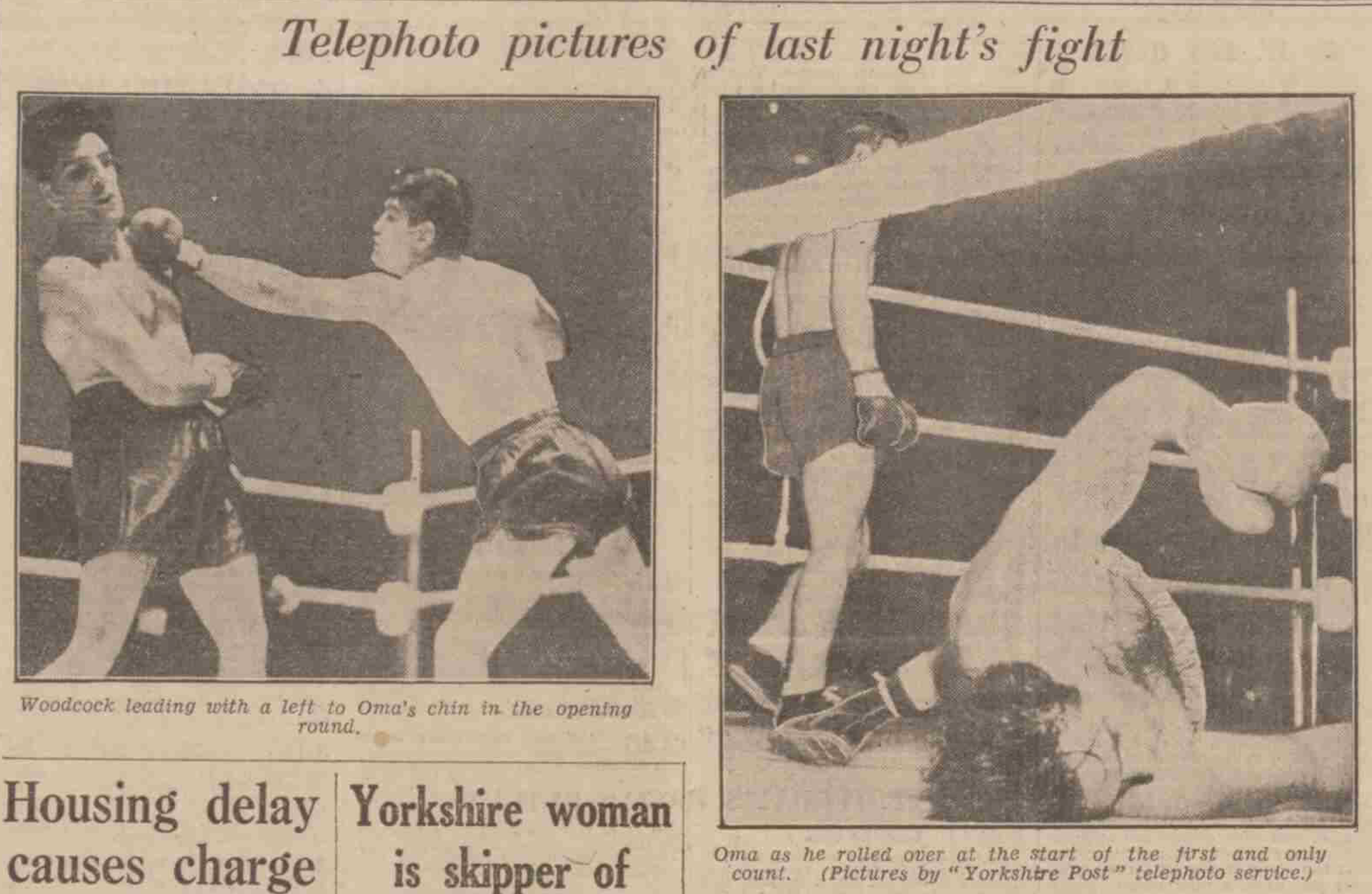
As for Oma, there was some explanation of his writhing in press reports like this in the
Hull Daily Mail:
“The Boxing Board of Control doctor said last night that Oma’s writhing in the ring after the knockout was due to intense pain from the mastoid bone, on which he had received a blow earlier in the fight.
Oma's manager, Willi Ketchum, said today ‘Lee rolled about in pain nearly all night and did not drop off to sleep until 7 o’clock this morning.’
The Board’s doctor said that when he examined Oma in the ring after the count, there was no movement in the eye, and Oma was unconscious. This was due to the mastoid bone being damaged, and not from the knock-down punch. He advised Oma’s manager to take the boxer to hospital
‘I feel simply terrible,’ said Oma on waking, ‘my head is throbbing, and the pain in my ear is almost unbearable. I guess the doctors will have to look at it this morning. I'm sorry put up such a poor show last night, but Woodcock punches very hard and the pain in my head robbed me of senses.’”
His ear was still bleeding when he returned to New York a few days later.
A Fix ?
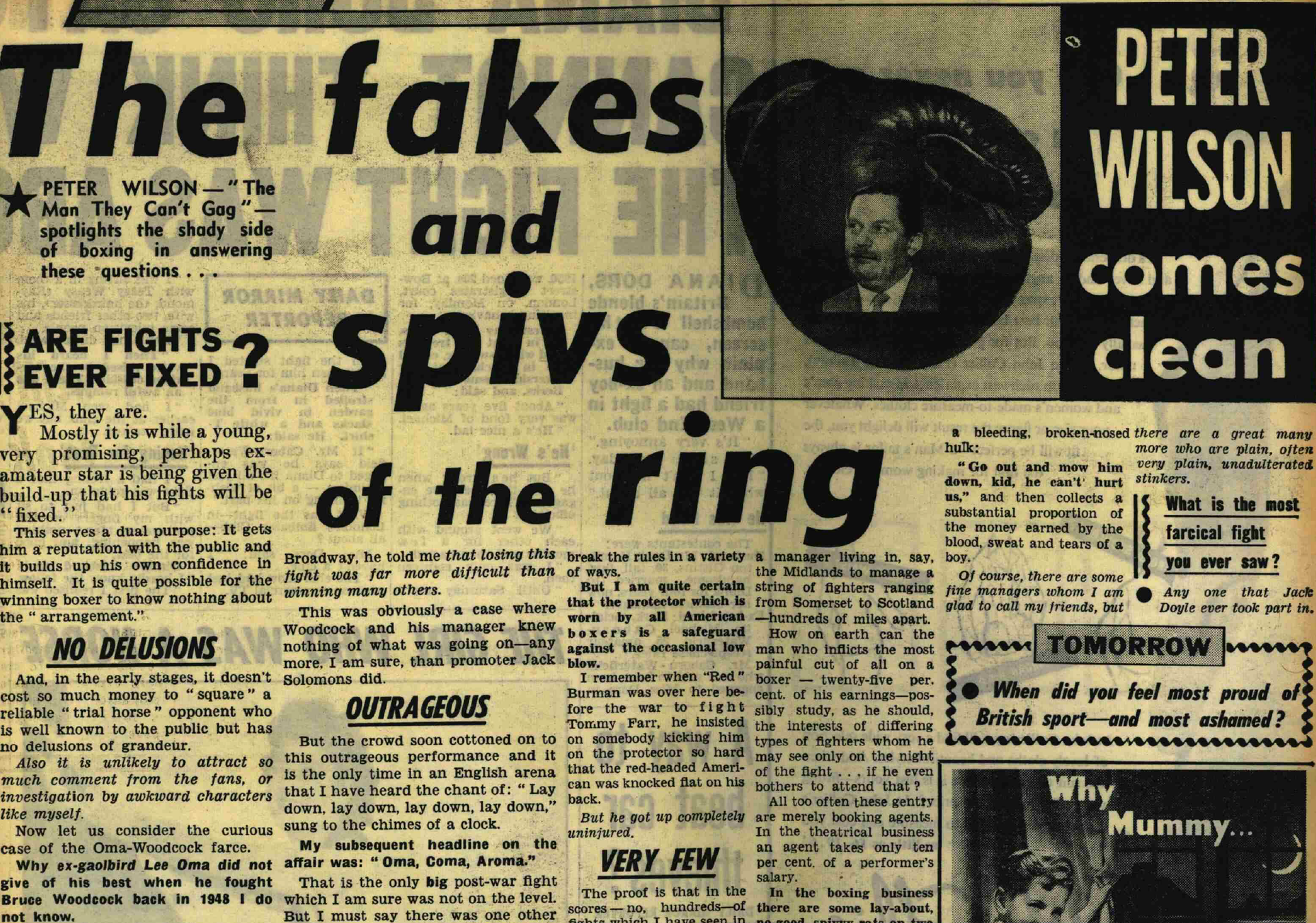
But the memory of this bout rumbled on for many years. In 1955, Peter Wilson resurrected it for a piece in the Daily Mirror which debated whether boxing contests were ever fixed (28th September 1955).
Under the headline “The Fakes and Spivs of the Ring”, this is what he had to say about what he called “the curious case of the Oma-Woodcock farce”:
“Why ex-gaolbird Lee Oma did not give of his best when he fought Bruce Woodcock back in 1948 I do not know.
But I am certain that he didn’t. Because when I subsequently saw Oma, who was then working in New York as a bar tender in a saloon on Broadway, he told me that losing this fight was far more difficult than winning many others.
This was obviously a case where Woodcock and his manager knew nothing of what was going on - any more, I am sure, than promoter Jack Solomons did.
But the crowd soon cottoned on to this outrageous performance and it is the only time in an English arena that I have heard the chant of ‘Lay down, lay down, lay down, lay down,’ sung to the chimes of a clock.
My subsequent headline on the affair was: ‘Oma, Coma, Aroma.”
That is the only big post-war fight which I am sure was not on the level.”
Or a Fiasco ?
Jack Solomons himself admitted the fight was “a fiasco” in his 1951 ghosted autobiography, but looking back at the criticism he came in for at the time, he vehemently denied any wrong doing:
“Woodcock v. Oma was a fiasco, and nobody knows it better than I. If criticism is good for the soul, then I got pretty near to paradise over the affair. But I did claim, and still do, the right to resent the ugly rumours that ran round Britain and America as a result of Oma's palsied performance.
To put it as bluntly as possible, I was accused, behind my back, of having staged a crooked fight. Well, I can do no more than to deny it all over again - utterly, completely and sincerely. I’m no angel, but neither am I a mug. I know exactly how much chance I should have of staying in business if ever I attempted to ‘fix’ a fight.” [Jack Solomons Tells All, p. 134]
