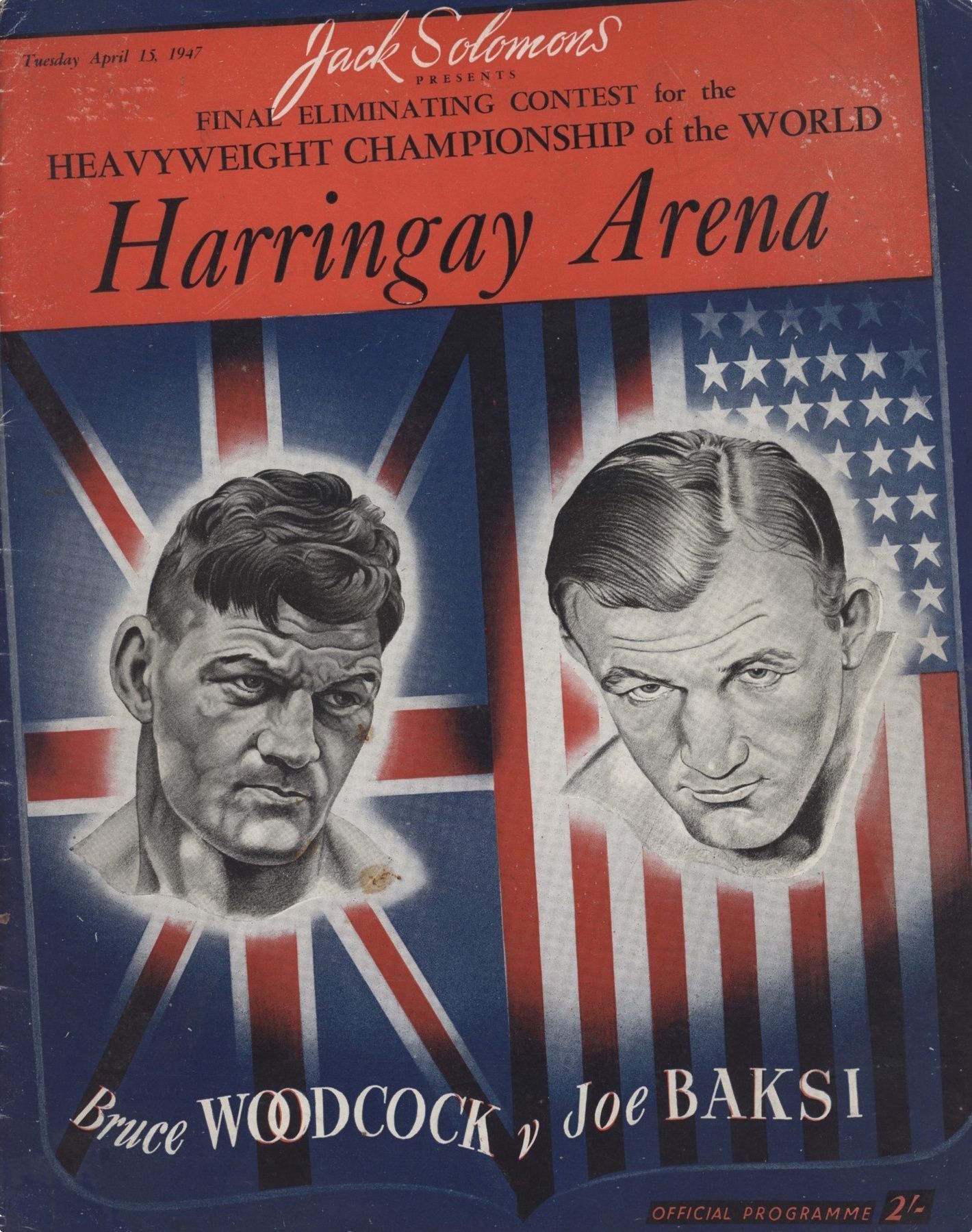
15th April 1947: Bruce Woodcock v Joe Baksi, Harringay Arena
A Legendary Fight
Context
And so we come to Bruce’s most difficult fight and the most difficult to write about. This fight effectively ended his hopes of the world title, although it didn’t necessarily seem so at the time. It also effectively ended his career, as despite a heroic and remarkable comeback from this devastating defeat, winning four out of six more big contests over the next three years, the damage inflicted by this bout was so severe it eventually inevitably took its toll.
The fight against Baksi is legendary in the annals of British boxing for a number of reasons: Bruce’s courage, foolhardiness, the oh-so-close-ness. It also exposed poor management: it’s generally agreed that he should never have fought Baksi at this point and needed a longer build up.
It was probably the most hotly anticipated contest of Bruce’s career because this was the doorway to a fight later this year for the World Title against the long-standing champion, Joe Louis. This prize had been at the forefront of the minds of commentators, analysts and fans alike for a long time. And also in the minds of Tom Hurst and Bruce himself.
The press speculation had been building through the end of 1946. By January 10th 1947, as Baksi left the US for the UK, James Butler was predicting ‘we can look forward to seeing what may prove the outstanding heavyweight scrap of the decade.’ Even before the date of the fight was announced on the 8th of February by promoter Jack Solomons, 50,000 people had applied for tickets in an arena that seated merely 10-11,000. By mid-March, Solomons’ box office in Great Windmill Street was being broken into and tickets stolen.
The Fight Programme
Background
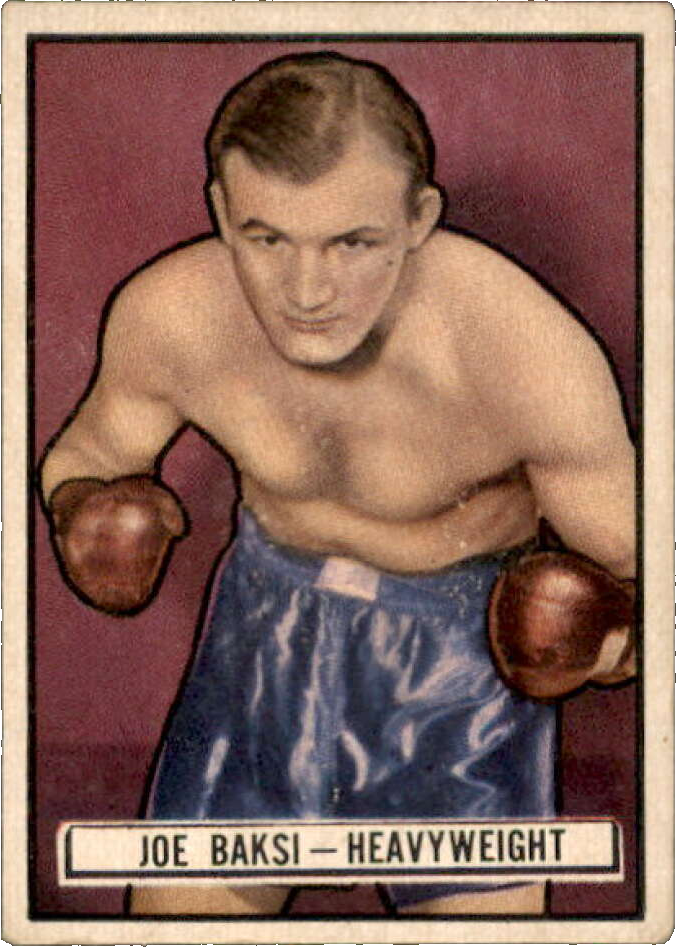
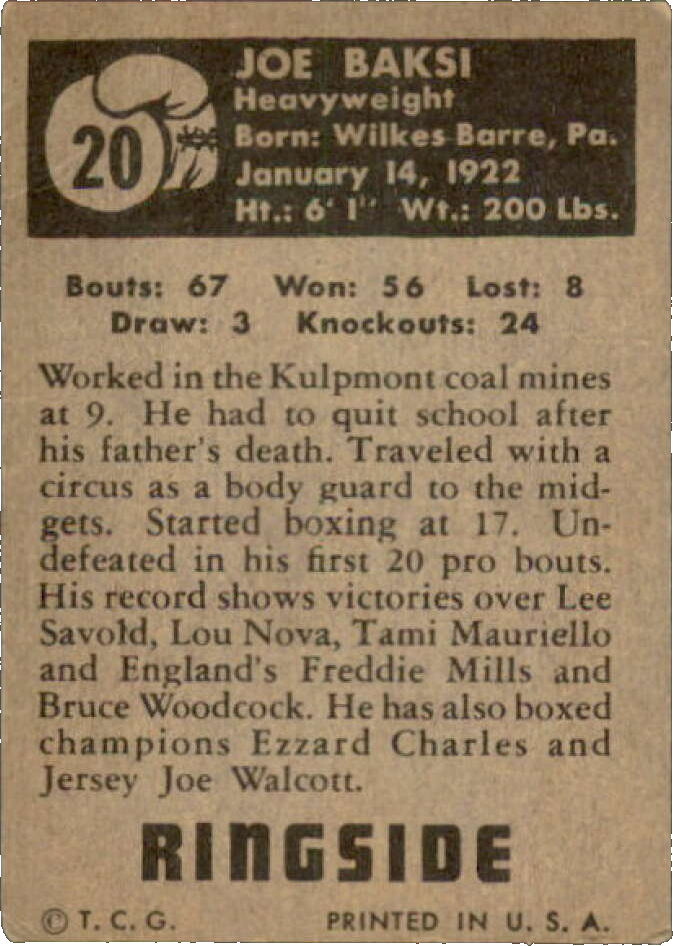
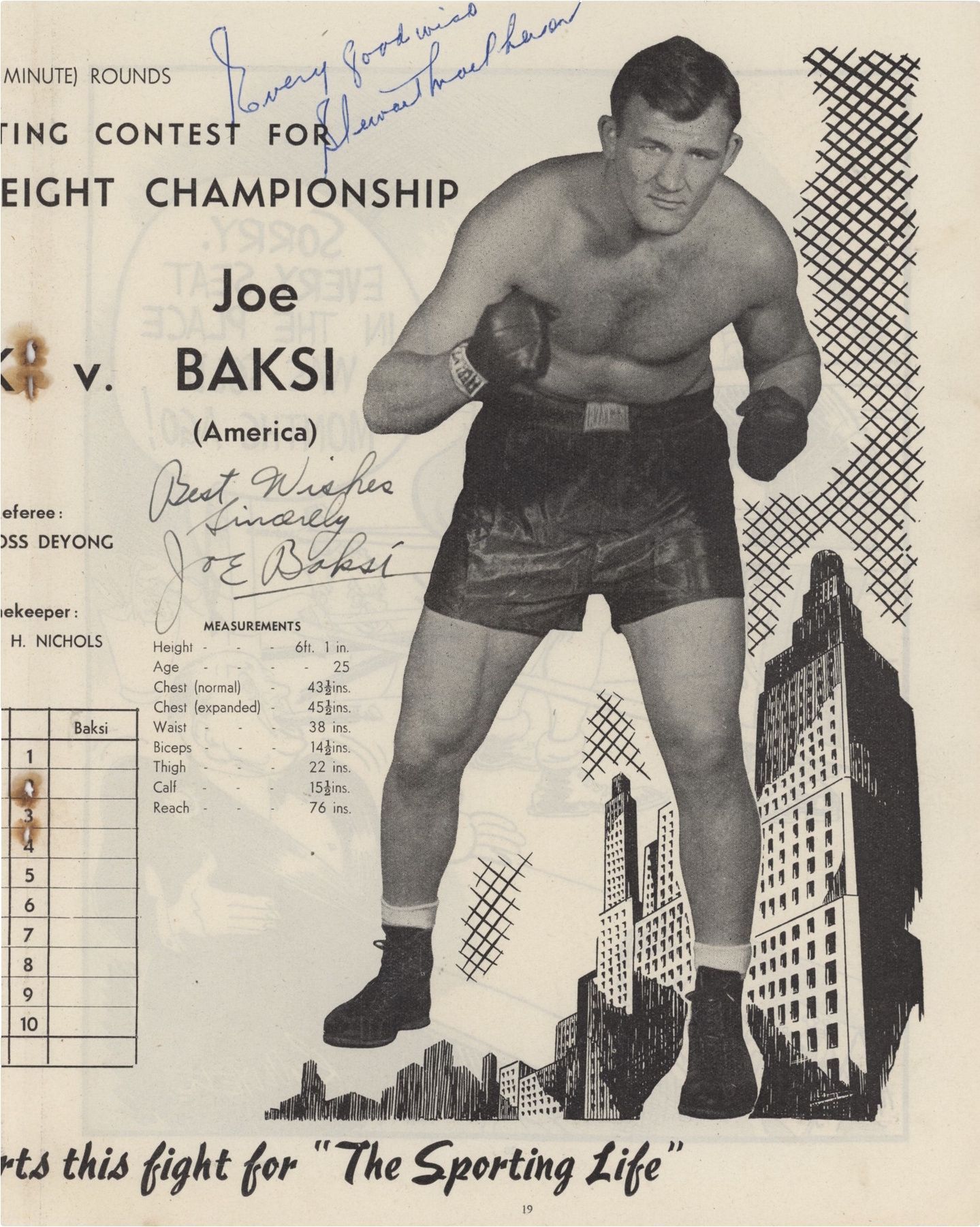
Baksi, a 25 year old former Pennsylvanian miner, had been boxing professionally for six years. He helped to fund himself with a part-time career as a circus hand. Known for his ‘iron chin’, Baksi was knocked down only once during his whole career - in this fight against Bruce. Like Bruce, he saw boxing as his way to a better life, ‘out of the coal mines’. He became a professional in 1940 aged 18, and won nine fights in that first year, one of them against future movie star Jack Palance. His breakthrough fight was in 1944 against Tami Mauriello, who he beat against the odds. He went on to win against Lee Savold in a rematch and rose to 4th in the N.B.A. rankings. But Baksi’s most ominous victory for the Woodcock camp came in 1946 when he defeated Freddie Mills at Harringay on the 5th November.
At the time of this fight, Baksi was rated eighth in the ranks of contenders for the world title - Bruce was rated fourth. Baksi had a significant weight advantage (15 st 3½ lbs., to Bruce’s 13 st 12½ lbs) and had a reach advantage too. Bruce had a heavier punch and was the more skilful boxer, but that couldn’t take the edge off the most obvious difference - Baksi was huge compared to Bruce.
Both men took their training for the fight deadly seriously. Joe had brought no sparring partners over with him. During the voyage he ran five miles per day around the deck of the boat to keep fit. Now and again, he visited the ship's gymnasium for a work-out before landing at Southampton on the 13th of February. Once settled in Brighton, he trained harder than he ever had before, although he attracted enormous amounts of publicity.
Bruce’s manager Tom Hurst took the tactical decision to move Bruce’s training from the familiar old Plough Inn barn to Gwrych Castle in the North Wales holiday resort of Abergele. Hurst hired two sparring partners from Manchester, Tommy Dolan a professional from the later 1930s, and Chris Hignett, a promising 19-year-old heavyweight who had his only four professional bouts during the year of 1947.
Hignett later recalled his impressions of Bruce at that time:
“The Woodcocks were a very clanish family, nice hospitable people but extremely close and they kept themselves to themselves. Bruce was a dour-faced man with little sense of humour and seemed very suspicious of strangers. He wasn’t the friendly type, laughing and joking with the other lads but in fact he never socialised with us at all. [. . .] I admired Bruce as a boxer, he was fast, had a stinging, accurate left jab and he had plenty of power in that right hand of his. He carried knock-out drops in that punch. The sparring partners used to all get changed into our gym togs together but Bruce would change on the opposite side to us. Apart from a quick ‘hello’ or ‘good afternoon’, he hardly ever held a conversation with any of us. He was a surly and moody fellow but this was understandable. All fighters get like that before important fights. Personally, I believe he wasn’t happy with all the fuss and publicity he was receiving. It seemed like the adulation was a huge burden on his shoulders and remember, he was the biggest sporting celebrity in the whole of the British Isles in those days after the war.” [quoted in Brian Hughes, Battling Bruce, p.117]
This is a telling glimpse in a number of ways, not least because it doesn’t sound at all like Bruce. He was generally a quiet but easy-going personality who loved a laugh. But Hignett puts his finger on something about this time - Bruce doesn’t sound at all settled or comfortable with what’s going on around him. He’d started the year badly with illness and then a sluggish victory over Olek that did him no favours and this led to a backlash of media criticism for the first time in his career.
The Photo Shoot
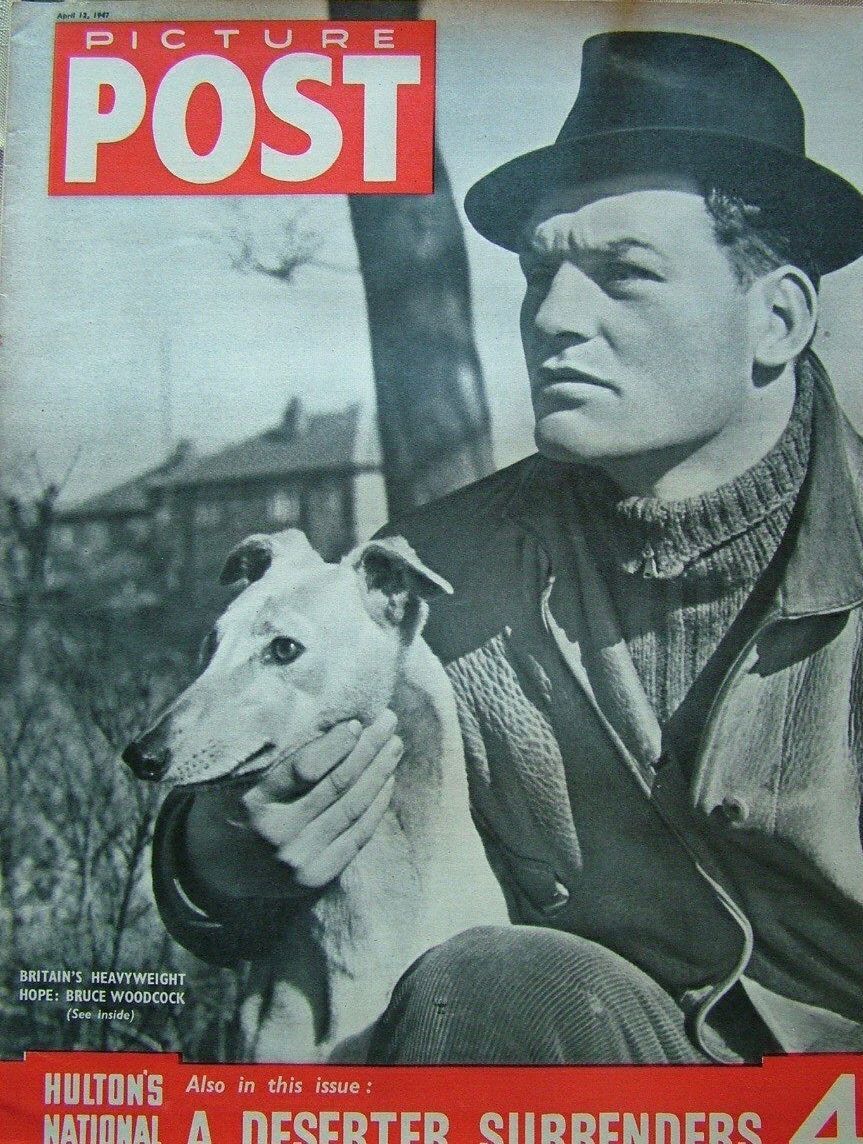
The increasing publicity circus around him was threatening to invade the sanctuary of Bruce's newly married life. This threat was dramatically realised later in the year when he was featured on the front cover of the upmarket Picture Post magazine on the 12th of April. The staged photo shows him dressed in trilby and roll-neck jumper with his greyhound Tip alongside. He doesn’t look at all comfortable in this artificial role. The photos in the inside feature look a bit more natural, showing him striding though the local woods on a rabbit shoot with his brother Billy. Both men are carrying shotguns, with Tip pacing beside them. Other shots show Bruce relaxing over games of snooker and dominos in his local workingman’s club with friends from the Plant railway works.
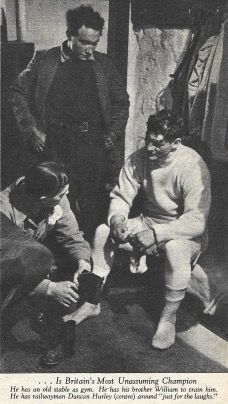
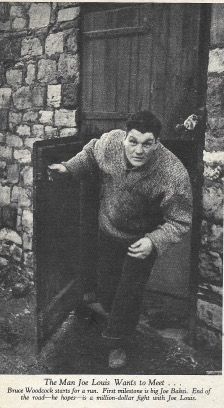
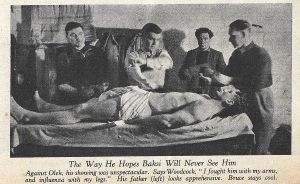
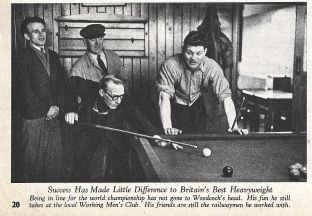
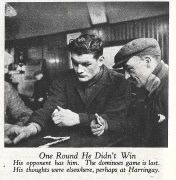
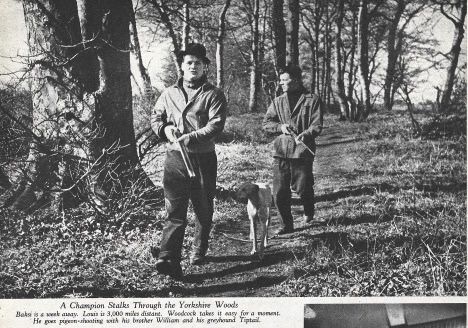
Or was the unease due to the prospect of fighting the huge Joe Baksi himself, who had demolished the much smaller Freddie Mills the previous November ? This is less likely. As the actual fight itself proves, Bruce was not one to flinch from facing whatever he came up against. As he is quoted as saying in the Picture Post feature, “I’ve seen Baksi. He is a strong fighter. What you call rugged. But I think I’ll have him.”
But we can see in the existing footage that, when the fight against Baksi starts, Bruce looks unusually on edge. Something wasn’t right!
In Training
The flavour of Bruce’s preparation was captured in this brief portrait by the boxing correspondent of the Evening Despatch on the 10th of April:
BRUCE WOODCOCK is fighting fit (writes a special correspondent). That fact I can state with confidence after seeing the British heavy-weight champion go through a grilling non-stop work-out at his training headquarters above the famous stable at the Plough Inn Doncaster. There can be little doubt that Joe Baksi will meet a super-keen and trained-to-the-ounce Bruce when the two boxers touch gloves at Harringay on Tuesday.
I watched Bruce tear in to over an hour’s vicious training which he commenced by demonstrating the power of his ‘short smash’ right on the face of helmeted Alf Brown, Southern area heavyweight champion. Bown’s helmet was knocked clean off his head and his nose was bleeding, but he showed toughness by throwing everything he had at the champion for a couple of rounds.
It was left, left, left, when Jack Tansey of Liverpool took straight over, but he withstood the storm for another couple of rounds, and two lighter sparring partners had a round apiece to give Britain’s hope some speed exercise.
Then Bruce flies shadow-boxing round the ring - it is dangerous to get in his way, for he is quite liable and does ‘take a poke’ at anyone foolish enough to venture through the ropes. Tom Hurst keeps him at it. ‘Rat-a-tat-tat’ goes the ‘play ball’, ‘bonk-bonk-bonk’ goes the punch ball, and then an unfortunate helper skips backwards round the ring with a punch ball held in front of his face, imploring the champion to remember that the ball, and not his head, is the target. Skipping, more punch balling, shadow boxing, and yet more skipping.
Says Bruce when it’s all over - “I’m feeling fine, I’m feeling very fit indeed. My weight? Well, that’s secret, but I think it will be down. I think my chance is very good. I saw Baksi fight Mills, and he’s a good strong fellow.”
Plans for the fight? The champion’s face breaks into that slow grin of his. “Well, you had better ask Tom Hurst.”
Tom doesn’t give a lot away as the following interview will show:
Myself: “What’s Bruce’s weight going to be for the fight?”
Tom: “Well, that you can guess.”
Myself: “What hopes of success have you got?”
Tom: “Well, you know what our hopes are.”
Myself: “What do you think of Bruce’s condition?”
Tom: Well you can see that for yourself”
Myself: "Any special plans for the fight?”
Tom: “. . . .”
But answer came there none
My conclusion is Bruce Woodcock going into the ring fitter than ever before to take Baski as he comes. He knows Baksi’s in fighting reputation and the type of sparring Bruce is undertaking indicates that he will be well prepared for the best the American can throw at him.
In Hiding
Before the fight itself, Baksi stayed in bed at Brighton until it was time to leave for London for the weigh-in to-day, but he broke his rest to say that, win or lose at Harringay, he would “put up the fight of his life”. “I expect to win,” he said, but “I do not intend to underrate Woodcock.”
When Bruce arrived in London the previous day manager Tom Hurst and promoter Jack Solomons found they had lost the champion when his train reached King's Cross. Bruce had taken one look at the vast waiting crowd and had dived back into his carriage. Obliging railway police locked him in till he could be escorted through the crowds, who called good luck greetings to him as he left in a car with his brother Billy, Hurst and Solomons.
At his hotel, Bruce spent most of the morning in bed, after a visit to the London Palladium the previous evening. Both men had a light breakfast, aiming to eat their main meal after the weigh in at Solomons’ gymnasium, and rest for the remainder of the day before going to the arena. Bruce kept away from the crowds. He would not receive callers, and the telephone was disconnected.